

Demonstrating Impact: How the Employee Incentives, Rewards and Recognition Industry Actually Stacks Up
Clicks. Likes. Points issued. Awards sent. Logins per month. Here’s what platforms should really tell you.
By Jason Etter,
Vice President, Growth, WorkProud
Engagement Metrics (Clicks, Opens, and Points) are Insufficient Indicators of True Business Impact
The Employee Experience Was Never a Perk
The Engagement Crisis Is Real and Measurable
The Recognition Gap Across Industries
Too Many Tools, Not Enough Signal
Measuring Behavior, Not Just Clicks
From Activity Reporting to Outcome Measurement
Employee Rewards and Recognition Provider Landscape: What Is Really Being Offered?
How to Use This Table in an RFP or Vendor Evaluation
What Buyers Should Demand Next: Buy Outcomes, Not Features.
Click here to subscribe to RRN weekly, and here for an RRN media kit.
That gap is why recent list-style articles of companies in our space provide no context on the vendor, what outcomes to expect, or even the financial impact. They don’t help a CHRO defend spend, a CFO justify investment, or a board understand why employee experience deserves to be treated as a strategic lever rather than a discretionary perk.
Recognition works. But only when it’s intentional, measurable, integrated, and taken seriously. The next chapter of the employee rewards and recognition industry won’t be written by who tracks the most clicks or recognition points--it will be written by those who can prove, in plain business language, why employee experience belongs in the boardroom. That’s the bar. And it’s time we hold ourselves and our partners to it.
This article is an attempt to reset that conversation and help buyers identify what to look for in a solution provider in the world of incentives, rewards, and recognition.
Engagement Metrics (Clicks, Opens, and Points) are Insufficient Indicators of True Business Impact
Let’s start with an uncomfortable truth. Most employee rewards and recognition platforms measure activity, not impact. That’s not inherently wrong (activity data is necessary), but it’s wildly insufficient if it’s the end of the story. Tracking that an employee received points, shopped for a gift, or that a manager sent a recognition message tells you nothing about:
- Whether that recognition changed behavior
- Whether it influenced retention, performance, or engagement
- Whether it reduced unwanted turnover
- Whether it delivered a financial return relative to cost
Boards don’t fund dashboards. Finance doesn’t approve feel-good metrics. And executive teams increasingly expect HR investments to be defended with the same rigor applied to any other strategic initiative. This is where the industry must evolve--from counting moments to connecting behavior, outcomes, and financial impact.
The Employee Experience Was Never a Perk
The idea that employee experience is a “nice-to-have” perk is not just outdated--it’s financially irresponsible. According to Deloitte’s 2025 High-Impact Total Rewards Research, organizations with mature, integrated rewards strategies are:
- 3.1x more likely to optimize ROI on total rewards investment.
- 1.5x more likely to retain high performers.
- Delivering 55% higher three-year earnings per share (EPS) compared to low-maturity peers.
That’s not culture fluff. That’s enterprise performance. The challenge: many companies fail to rigorously track these metrics for their own organizations.
The Engagement Crisis Is Real and Measurable
Gallup’s State of the Global Workplace continues to show sobering results:
- Only 21% of employees globally are engaged at work.
- Gallup estimated that disengagement costs the global economy $438 billion in 2024 through lost productivity.
Engagement is not about ping-pong tables or Slack emojis. It is the cumulative result of whether employees feel seen, valued, supported, and connected to meaningful outcomes. It is the cumulative result of whether employees feel seen, valued, supported, and connected to meaningful outcomes. Recognition, when applied consistently and measured correctly, is one of the most direct levers leaders have to influence that equation.
The Recognition Gap Across Industries
Gallup has also found that 52% of employees who quit said their departure was preventable, and more than half reported that no one had discussed their satisfaction or future with them before they left. That’s not a compensation problem. That’s a visibility and connection problem.
Recognition systems that surface patterns, gaps, and behaviors-rather than just transactions- give leaders early warning signals instead of exit interviews after the damage is done.
Too Many Tools, Not Enough Signal
Forrester’s Predictions 2026: The Future of Work frames the current operating environment clearly. Disruption is no longer episodic. It is ambient. High-maturity organizations are converging on a different model: one unified employee experience, delivered through a single, coherent framework.
Recognition, milestones, spot awards, rewards, and communications aren’t separate programs-they’re expressions of the same cultural and behavioral system. Deloitte’s research reinforces this directly. Mature organizations are 3.7x more likely to integrate rewards systems under a centralized platform, and 3.8x more likely to support multiple form factors, including mobile, to meet workers where they actually are.
Measuring Behavior, Not Just Clicks
This is where leading platforms have intentionally drawn a line. Most systems answer: What happened? A platform designed for impact focuses on:
- Why it happened.
- What changed afterward.
- Who is engaging-and who is being missed.
- How recognition correlates to retention, participation, and performance.
Independent industry studies consistently show statistically significant gaps in recognition, respect, and perceived valued value, with direct correlations to job satisfaction and intent to stay.
From Activity Reporting to Outcome Measurement
Those metrics are useful, but they are not sufficient. Outcome-oriented organizations go further by connecting recognition data to:
- Participation trends over time.
- Retention and tenure patterns,
- Manager consistency and coverage gaps.
- Behavioral signals that precede disengagement or attrition.
When leaders can see who is being recognized, who is being missed, and how those patterns correlate with retention and engagement, recognition becomes a management tool instead of a morale artifact.
An independent study conducted for WorkProud by Rick Garlick, a research specialist in customer and employee engagement, reinforces this distinction. It shows that moderate pride has little effect on outcomes, while high pride correlates strongly with engagement, advocacy, and intent to stay.
Employee Rewards and Recognition Provider Landscape: What Is Really Being Offered?
Too many industry comparisons treat all employee rewards and recognition providers as interchangeable, when in reality they represent fundamentally different solution categories with very different cost structures, risks, and outcomes.
By contrast, the approach taken in Build vs Buy: Evaluating Global Rewards Fulfillment for Incentive and Loyalty Programs forces vendors into the same comparison frame. Many failed implementations do not fail because the technology was inadequate, but because the provider model was mismatched to the organization’s internal capabilities and desired outcomes. Here is an example of different types of providers; their capabilities, business models, and applications. Note that this does not constitute a complete list but rather examples of the different options.
| Provider Type | Example Providers | Delivery Model | Reward Types Supported | Global Fulfillment Reality | Operational Burden on Buyer | Best-Fit Use Case |
| Digital Incentive APIs | Tremendous,Giftbit, Runa | API or developer-first | Digital gift cards, cash equivalents | Limited or digital-only | High (buyer owns experience, logic, reporting) | Product-led incentives, transactional rewards |
| Gift Card Networks | Blackhawk Network | API plus network | Gift cards only | Broad reach, gift-card centric | Medium (integration, reconciliation, breakage mgmt) | Large-scale gift card distribution |
| Catalog and Fulfillment Engines | CarltonOne,Runa API | API-driven fulfillment | Gift cards, merchandise, experiences | Strong global coverage | Medium (integration and ops oversight required) | Embedded rewards, custom apps & loyalty platforms |
| Engagement Platforms | O.C. Tanner, Achievers,Workhuman | SaaS platform | Recognition, awards, limited rewards | Varies by vendor | Low to Medium | Engagement and culture transformation programs |
| Unified Employee Experience | WorkProud | SaaS platform | Recognition, milestones, spot bonuses, comms. | Global with local support | Low | Enterprise-wide culture + ROI measurement |
How to Use This Table in an RFP or Vendor Evaluation
Many RFPs fail by assuming all IRR vendors solve the same problem. They do not. Buyers can use this table to create a more defensible evaluation process.
Step 1: Identify the problem you are trying to solve. Before issuing an RFP, align internally on the primary objectives:- Reducing unwanted turnover.
- Improving frontline engagement.
- Consolidating multiple recognition and rewards programs.
- Gaining financial visibility into total rewards spend.
- Supporting a global or distributed workforce.
- Embedding rewards into existing systems or workflows.
Different provider types are optimized for different outcomes. Selecting the wrong category guarantees poor results, no matter how strong the demo looks.
Step 2: Eliminate entire provider categories that do not fit. Use the table to remove solutions that do not align with your operating model:
- If you do not have development resources, eliminate API-only incentive providers.
- If you need global fulfillment beyond gift cards, eliminate gift-card-only networks.
- If you are trying to replace multiple programs and tools, eliminate single-function platforms.
This step alone can reduce your vendor list by 50% to 70% and dramatically improve RFP quality.
Step 3: Assign ownership and operational accountability
For each remaining provider, require clear answers to the following:
- Who owns fulfillment, fraud prevention, and support?
- Who manages liability, returns, and exceptions?
- Who is responsible for global compliance and localization?
- Who supports reporting, audits, and budget forecasting?
If ownership is unclear or pushed back onto your internal teams, the total cost of ownership will be higher than advertised.
Step 4: Require outcome and financial reporting, not just activity In your RFP, explicitly require vendors to demonstrate how they measure:
- Behavior change over time.
- Retention and participation outcomes.
- Program effectiveness by manager, department, or role.
- Financial impact, including turnover avoided and productivity gained.
Step 5: Evaluate long-term scalability, not pilot success. A strong pilot does not guarantee enterprise impact. Ask vendors to show how their solution scales across:
- Multiple populations and geographies.
- Frontline and desk-based roles.
- Multiple recognition and reward use cases.
- Year-over-year budget planning and governance.
The goal is not to launch a program. The goal is to operate a system.
What Buyers Should Demand Next: Buy outcomes, not features.
- Connect recognition to behavior and retention.
- Translate engagement into financial language.
- Replace tool sprawl with a unified experience.
- Deliver executive-ready insights-not vanity metrics.
- Treat employee experience as a strategic system, not a perk.
The industry doesn’t need fewer platforms. It needs better standards.
Enterprise Engagement Alliance Services
Celebrating our 15th year, the Enterprise Engagement Alliance helps organizations enhance performance through:
1. Information and marketing opportunities on stakeholder management and total rewards:
ESM Weekly on stakeholder management since 2009; click here for a media kit.
RRN Weekly on total rewards since 1996; click here for a EEA YouTube channel on enterprise engagement, human capital, and total rewards insights and how-to information since 2020.
2. Learning: Purpose Leadership and Stakeholder
 Management Academy to enhance future equity value and performance for your organization.
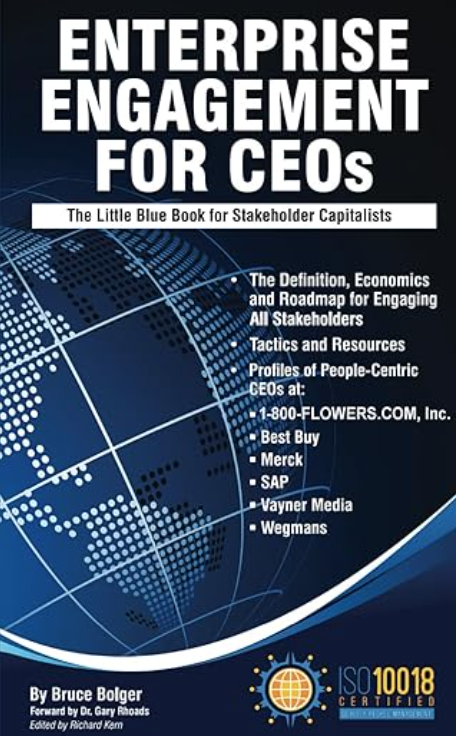
3. Books on implementation: Enterprise Engagement for CEOs and Enterprise Engagement: The Roadmap.
4. Advisory services and research: Strategic guidance, learning and certification on stakeholder management, measurement, metrics, and corporate sustainability reporting.
5. Permission-based targeted business development to identify and build relationships with the people most likely to buy.
6. Public speaking and meeting facilitation on stakeholder management. The world’s leading speakers on all aspects of stakeholder management across the enterprise.